social

Facebook Twitter Blogger Pinterest Instagram YouTube

menu

About Us Contact Us News Faq Tutorials Our Shop

giveaways ad

Showing posts with label fabric consultant. Show all posts

Tuesday, November 12, 2013

How To Tuesday: Knits

    So as our collection of knit patterns grows here at CKC, so does the amount of questions that we receive from our amazingly talented fans. Trust me I get it, knit is scary! Heck, it took me ten years to muster up the courage to sew with knits. Surprisingly enough, I was shocked by how simple it was. I think we over complicate knit it in our minds. And yes, there are few extra little steps that are needed--well not even needed but HIGHLY suggested and will make sewing with knits about 100 times less stressful. So prepare yourself for knit overload!!


    I'm sure that most of you all have read the tips that Heather from Girl Charlee gave us back around this time last year. Along with the Double Needle How To that Julie did for us we have a great base point to jump from. So lets 1st go over the types of knits and what type of knit best suit our patterns and what type of knit we suggest to a beginner.

    So let’s start at the very beginning: what is a knit fabric? Where woven fabric is made of horizontal and vertical threads being woven together, knit fabrics are made by threads being looped back and forth to form the fabric. Or as I like to call it "mini knit" if you have ever knit before you understand what I mean. ;) 


So now lets go over some of the more popular knit fabrics.


Interlock

    Interlock knit is ideal for those who are just learning to sew with knits. Interlock knits are fairly thick and don't do that scary curling when cut:. Interlock is pretty stable so as long as you're follow our tips and tricks for sewing with knit you should be just fine tackling your 1st knit fabric project.


Interlock fabric would be perfect for the following ckc patterns.

Cotton / Lycra Jersey


  Cotton jerseys are a lighter weight fabric and will roll when cut. Cotton / Lycra Jersey is made of cotton but with lycra added. These are soft and great for clothing and have the benefit of extra stretch and they recover and go back to shape nicely. There are different weights of cotton / lycra jersey, but the general rule of thumb is the heavier the weight the easier it will be to sew with.


And again I know that the curling maybe a bit scary to some. But follow the easy tips and tricks coming up and you will be fine, I promise!

Cotton and cotton/lycra jersey would be ideal for the following ckc patterns:


And while we are on the subject of the lycra. This is where the knit that is used for swimsuits fall in to place. Swimsuit lycra has added nylon.


Swimsuit lycra would obliviously be best for:

    So now lets move on to a helpful tips and tricks!


Cutting and Prepping Knit

  • Knits are known to shrink more then woven fabrics. For this reason it is important to prewash your knits.
  • Cut all pieces along the same grain. This helps with the stretch of the fabric and will help to ensure the fit of the garment.
  • Be sure to use the proper needle for sewing knit on your machine. For most that will be a Ball Point 14/90. Ballpoint needles have a rounded point that penetrates the fabric without catching or cutting the fabric
  • Make sure to use pins or pattern weights when cutting due to the curling of some knits.
  
Sewing with Knit
  • Do not pull the fabric as it goes through the feed dogs: you may risk breaking your needle and damaging your machine if you do.
  • Use polyester, nylon or poly cotton thread. Pure cotton thread lacks the elasticity that is needed for knit fabrics.
  • We suggest having your stitch length set to 3.

Seam Finishes

Knit fabrics don't generally unravel, so for most you can get away without finishing the seams. If your pattern does not call for a straight stitch, try a zigzag stitch. Zigzag stitches allow the seams to stretch and move easier. If your machine has a tricot stitch as pictured below, (on my machine it is the D stitch) USE IT!! this stitch is VERY flexible and perfect when sewing with knits. 


The best tip to finishing knit seams is clear elastic tape. The trick is to add the clear elastic tape on the top of all the seams of your garment. This helps prevent stretching and curling in the seams.


To start you will want to give the clear elastic a good stretch.  After following the directions in your pattern and pinning your raw edges together we will use the zig-zag stitch we talked about earlier to sew the clear elastic and the raw edges all together. 


This life changing tip is highly suggested when also sewing any type of skirt to a knit bodice. In a pattern like this you will want to first sew the elastic to the knit bodice before attaching the skirt. In this case the clear elastic is being sandwiched between the bodice and skirt. This helps prevent the weight of the skirt from pulling and stretching the bodice.

This trick can also be done with a serger.

 In the sample photo below the one on the left is the one that was sewn with the clear elastic. You will now note that your knit still have plenty of stretch, but it is stronger and this will create a much more durable seam. 


Hem Finishes
 Before hemming use the following the tip to create a clean and nicely laying hem. By doing so, you are adding a tad bit of extra weight to your knit. This helps the hem to fall and lay nicely.

Using a fusible interfacing cut a 1" strip to iron to the bottom edge (wrong side) of your garment. When doing this make sure that the stretch of your of interfacing is running in the same direction as the knit fabric.


Now that your interfacing is in place you can proceed to hem the garment in your desired way.  You can see that in the sample picture below I used the interfacing trick on the top piece.


If you take a look at store bought knit wear that you are most likely wearing at the moment, (sorry nudist!) you'll see most have hems with two row of stitching on the outside with a serger like stitch on the inside. (like the picture above)

Manufacturing companies use what is called a coverstitch machine to get this neat and tidy finished hem. But lucky for you, you do not need a coverstitch machine to get this look., Most machines can accommodate a double needle to help you acquire the same look. This needle may look a little funny but it sews a perfectly spaced double row of stitches on the right side of the fabric, with a zigzag on the wrong size. Create Kids Couture has a great blog all about sewing with a double needle that you can find HERE. I hope that this knit overload will help you tackle your fear of knit! 

Happy sewing y'all,
Morgan

Thursday, October 24, 2013

Tips for Sewing with Satin


Do we have those Halloween costumes ready yet? One week to go! 

I love Halloween because of the wide variety of costumes we see in the neighborhood!  I like to make them for my kids and it's fun to hear what they come up with. In fact my oldest son has such a random idea this year that I'm going to have to ask him again what it was!  All I remember is that it involves a shiny, black sheet.  Anyway, whatever your young ones are wanting to be this Halloween, I bet there's a good chance you can add flair to it by using shiny satin!  Yeah?  


Let's be honest, though. Working with satin for the first time may seem a little scary! Like going on a stroll through the cemetery on Halloween night and seeing a black cat cross your path, under the full moon. (Have you ever done that? It's scary!) But sewing with satin doesn't have to be. We have some great tips and tricks to share with you today, and before long you will be sewing satin like a witch! I mean... like a pro! 

I know you can do it, and even in time for Halloween. Here's the link to our downloadable PDF: 


And guess what! To make your knowledge of satin even more complete, on Monday we will show you how to make a couple different kinds of satin flowers. Your little ghouls will love that. 

Let's create!  ~ Kristen 


Thursday, January 24, 2013

Fabric Consultant---Basic Prints!!


Hello everyone at Create Kids Couture! It’s Kimberly from Fat Quarter Shop and I’m here to tell you a bit about fabric! We are surrounded by fabric here at Fat Quarter Shop and want to share some of the prettiness with you!

Today we are going to chat a bit about basics, but focusing on prints rather than solids, like we did last month! Prints are just plain fun. Adding a dot, a stripe or a chevron to your project can give it that extra something. It can turn a plain top into something hip. It can add that pop of color that you didn’t know you were missing. Incorporate prints into your projects (and stash) and keep them feeling fresh, fun and colorful.

Thursday, December 27, 2012

Sewing with Knits: Debunking the Mystery


Our friend Heather, owner of Girl Charlee, is stopping by today to talk to you a little about sewing knits. Until recently, most CKC patterns have been for woven fabrics, but now we are branching out into knits patterns, and we want to help take the mystery out of sewing knits. To be perfectly honest, I (Robin) was scared to death to try sewing knits for the first time, but Heather sent me a sample of her fabulous knit fabric to try, and so I dove in. I made a pair of Kelsey's leggings, and it was so much easier than I thought. Here's Abby modeling them, not bad for my very first try, right?


If you haven't taken the plunge yet, we hope this post will give you the confidence you need to dive in. To give you a little more encouragement, Girl Charlee is offering a discount code just for CKC fans: it's 10% off of your order if applied before checkout.

Wednesday, December 19, 2012

Fabric Consultant- All About Basics

Hello everyone at Create Kids Couture! It's Kimberly from Fat Quarter Shop! Are you ready to hear a bit about fabric? As the fabric consultant on Create Kids Couture, I will be stopping each month by to talk to you about what is happening in the world of fabric! We are surrounded by fabric here at Fat Quarter Shop and want to share some of the prettiness with you!
To make sure we cover our bases, we are starting with the basics. Basics, especially solids, are necessities in so many projects to tie cute and bold prints together! Solids sell really quickly around here because of their many uses. You can find them featured in many quilts and they have started to steal the show in the modern quilting community. Solids are also frequently used in apparel. All of you seamstresses should have a big stash of solids to use in your sewing projects.

Monday, October 1, 2012

Krista's Laminate Tips


Hi! I’m Krista, owner of MaeFlowers & JuneBugs, a small girls boutique here
on the web.  For those who don’t know who I am, you can find my Facebook page at

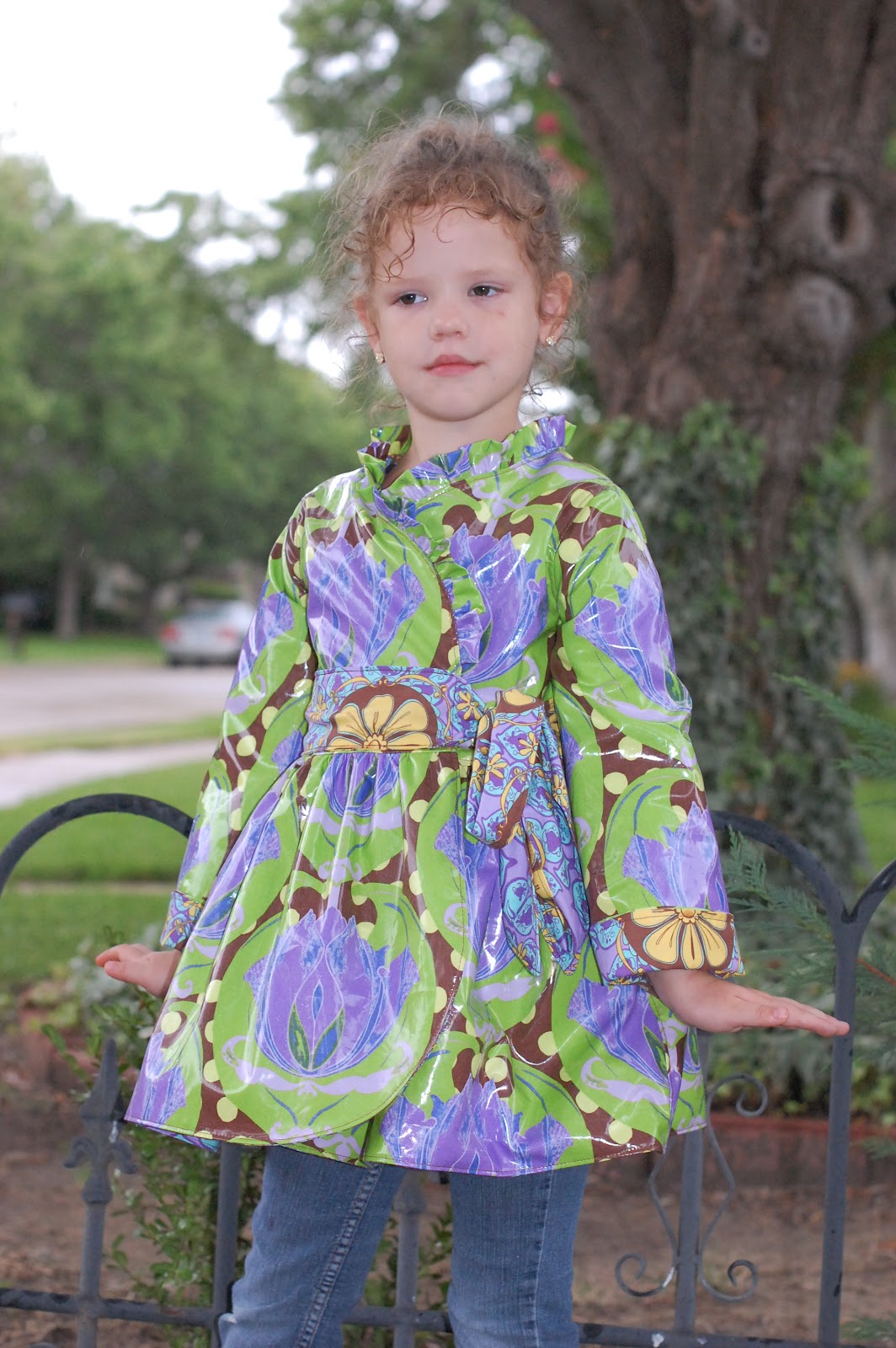
A few months ago, I was one of the testers on the awesome Willow Wrap
Jacket from Create Kids Couture.  Instead of being like everyone else, I
decided I would do something a little different and I made my jacket out of
laminated cotton, making it into a raincoat for my daughter.
Unfortunately, we live in Texas and she was only able to wear it for the
photo shoot.  She grew into a larger size before she was able to wear it,
so I’m left with the task of making a new one.  As I do that, I’m going to
walk through some tips to help you with any laminate sewing!

Thursday, August 23, 2012

What's hot this month- Fabric Consultant

Hi everyone! My name is Brenda and I own Pink Castle Fabrics. I'm interrupting Shannon and Tiffany's regular post today to talk to you all about fabric!
Each month I'm going to stop by and let you know what's coming up in the next few weeks and point out some things you should look for. The fabric industry is stepping up it's game and putting out more and more great lines and it's easy to get lost in everything that is coming out. I will do my best to highlight things I think are going to be big winners so you don't miss out!
To recap last month we talked about:
This month has been pretty hectic around here! New lines just keep filing in and each one is better than before. You may want to hide your wallet somewhere safe before proceeding to read this post!

Friday, December 23, 2011

How to Choose High Quality Cotton Fabrics

Matilda's Peasant Top
Nothing is worse than spotting the *cutest fabric ever* at a fabric shop like Joanns, and when you go to grab it from the shelf it feels similar to sandpaper. Ewwwwww...cheap cotton!

We talked yesterday about how to care for your handmade clothes made using cotton fabrics, so today we want to talk to you about how to choose cotton fabrics by teaching you how to differentiate between high and low quality cottons. If you have been sewing for awhile, this probably isn't going to teach you too much because at a certain point, you learn to tell whether a fabric has a "good hand" just by touching it. Thankfully, for beginner seamstresses, there are other ways to determine the quality of a cotton and we're going to teach you how now!